




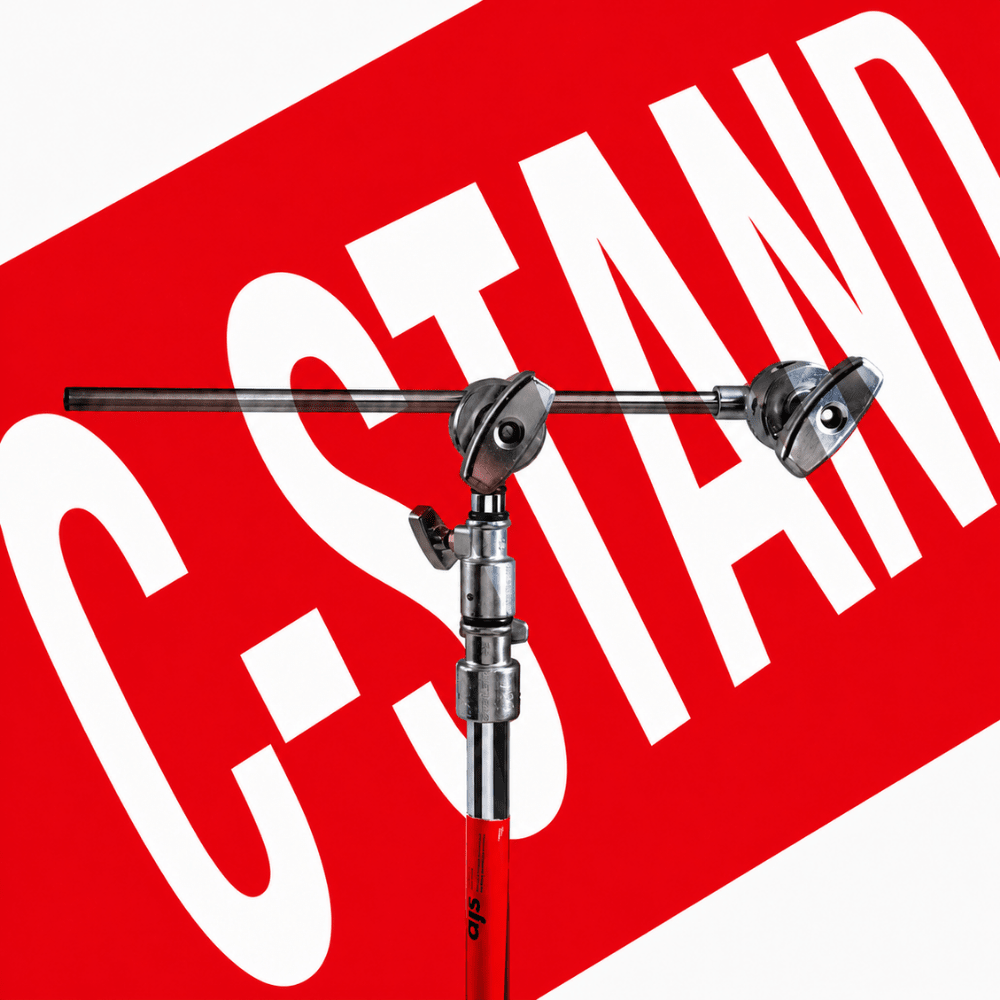
Let’s talk C-Stands: the heavy-duty studio workhorses used across film, video and photography. Also known as Century Stands, they are built to hold, support and position kit when a standard light stand just isn’t quite up to the job.
The C-Stand is best known for its clever turtle base: staggered, detachable legs that fold flat for easier storage and allow multiple stands to nest neatly together. The higher leg should always sit beneath the main load, while also leaving plenty of room for secure sandbagging.

Some C-Stands swap the turtle base for a sliding leg, which is especially handy on uneven floors or rough terrain. The trade-off, however, is that the base is fixed rather than removable.
The stand will often come with a grip head, although this does vary between models. Its heavy-duty clamp can hold extension arms, pins, spigots and accessories such as flags, reflectors and card.
Think of it as part giant retort stand, part mini boom arm: it can cantilever lights over subjects, boom them across tables and support larger scrims when a standard light stand isn’t quite up to the job.
So, why not just use a standard light stand?
A C-Stand is built for jobs that might require a little more strength and flexibility. Its heavier steel construction makes it better suited to larger lights and equipment mounted with a yoke, while the longer centre column leaves plenty of room for side arms and other grip accessories.
Despite its robust build, a C-Stand has a relatively small footprint and is available with different centre-column heights to suit different setups. Look after it properly and it is the sort of piece of kit that can stay in your studio for decades.

Matthews vs Avenger: what’s the difference?
Matthews C-Stands have a slightly sleeker, lighter design and are often seen as the industry-standard choice. They are also widely available in the UK, with strong distribution making them just as easy, and sometimes easier, to source than their European Avenger counterparts.

A real standout is the metal-to-metal, toothed grip head. It creates a vice-like lock that helps prevent slipping, even with heavier modifiers attached. The adjustment knobs are often preferred too, with smoother edges that make them more comfortable to grip and tighten.
Matthews stands also tend to have a slightly smaller footprint than comparable Avenger models. Their grip heads feature two sizes of hexagonal opening, giving you a couple of different options for pins and accessories.
Avenger C-Stands, meanwhile, tend to offer a slightly wider range of accessories and may be easier to repair, as their design makes individual parts more straightforward to replace. Their footprint is generally a little larger than the Matthews equivalent.
The handles have more defined edges and rubberised grips, which some people prefer, particularly when working in colder conditions.
Avenger uses smooth, toothless grip-head discs. These need a little more hand-tightening to lock securely, but they are less likely to warp the plates or leave unwanted marks. That can be especially handy when gripping card or other materials you would rather not attack with a row of metal teeth.
The grip head also features several round openings in different diameters. Price-wise, there is very little between the two, so it is likely to come down to which grip-head design, handle style and accessory range suits your way of working best.


Leave a comment
All comments are moderated before being published.
This site is protected by hCaptcha and the hCaptcha Privacy Policy and Terms of Service apply.